The capability extract shows in thirty seconds what runs as standard and what carries a surcharge.
See capabilities →Send the files and an engineer reviews them against your build — free, before you enquire.
To the data check →Every sector places different demands on the same board. Automotive needs IATF 16949 and PPAP, medical needs ISO 13485, railway needs EN 45545-2 — same production, different evidence.
The most demanding sector for documentation and process capability. It is not the technology that differs but the chain of evidence: sampling, traceability and change management across the whole programme.
With power LEDs, heat dissipation decides luminous flux and lifetime. The build-up is usually simple; the thermal design is the real bottleneck.
Sensor boards work with small signal levels. Interference from the build-up feeds straight into measurement accuracy — grounding and material consistency matter more than fine structures.
At 24 and 77 GHz, material consistency and etch accuracy set the performance. Hybrid build-ups place RF material only where it is needed and cut cost noticeably.
Long-term availability matters more than peak performance here. Plants run ten years and longer — material changes and obsolescence are the real risk, not the technology.
Documentation, traceability and validated change processes decide as much as the technology. The access is there through ISO 13485 — what matters is the evidence per lot.
From front camera units to battery management — LEXINGTON® boards run in more than twenty safety- and comfort-critical systems per vehicle.
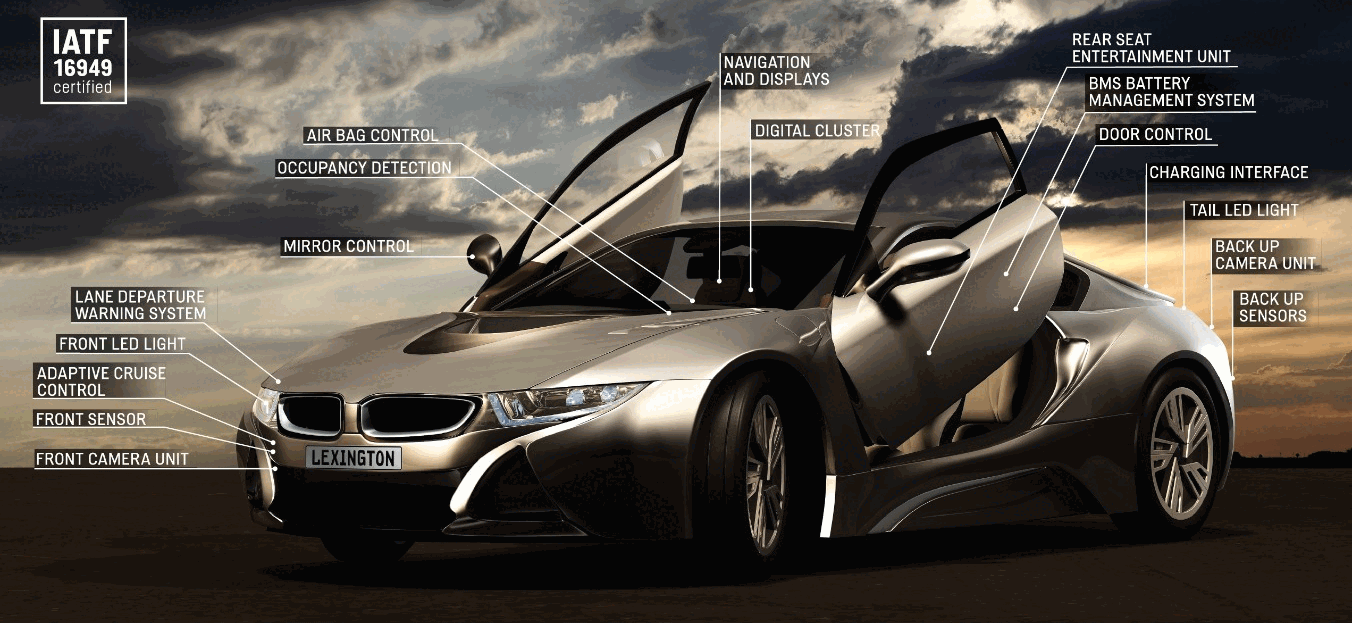
Series release to IATF 16949, including PPAP sampling and IMDS material documentation.
The production is the same — it is about the right evidence. Tell us which standards apply to you and we will check what we can document.