The capability extract shows in thirty seconds what runs as standard and what carries a surcharge.
See capabilities →Send the files and an engineer reviews them against your build — free, before you enquire.
To the data check →A prototype exists to answer a question. It is worth building it the way the series will be built, or it answers a different question from the one you asked.
Prototypes run on the same lines, with the same materials and the same test chain, as series work. That is the whole point. A cheap prototype built on a different process with a different laminate and a looser tolerance will pass, and then tell you nothing useful about the board you are actually going to ship.
What differs is the panel and the schedule. A prototype shares a panel with other jobs, which is what makes small quantities affordable, and it can be pushed through in three to five working days where a series runs to a normal lead time. An express build skips the queue, not the process.
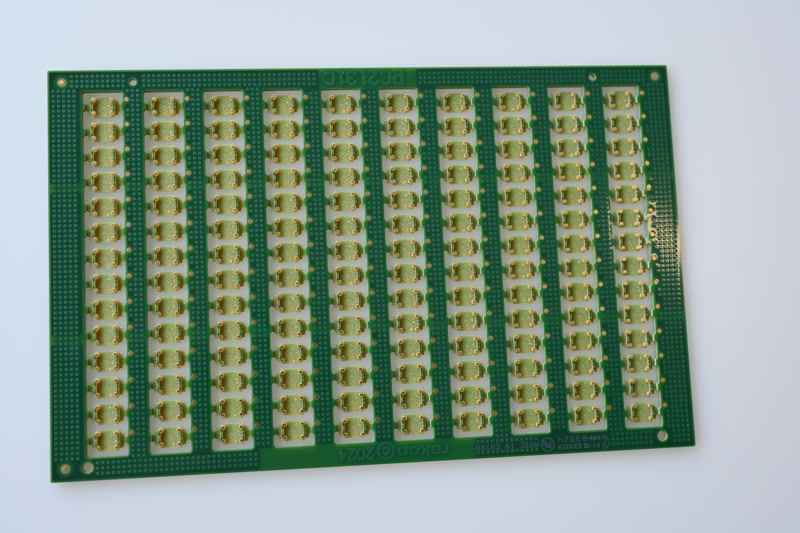
Same laminate, same plating, same electrical test. What you measure on the prototype is what the series will do.
From three working days for simple double-sided work, five to seven for multilayer. Express slots are available where the schedule demands it.
Every prototype goes through the same data review as a series job. Most problems get found there rather than after the board arrives.
| Feature | Specification |
|---|---|
| Material | FR-4, High-Tg FR-4, halogen-free; other materials on request |
| Layers | 1 – 12 |
| Quantity | 1 – 50 pieces |
| Lead time | 3 – 7 working days, express on request |
| Final thickness | 0.6 – 2.4 mm |
| Copper | 18 – 70 µm (standard 18 or 35 µm) |
| Surface finish | ENIG, OSP, lead-free HASL — ENIG standard |
| Typical use | Design validation, EMC and functional samples, pilot series |
The usual build for this line. Anything outside it is normally still possible — ask and we will confirm.
The clock starts at data approval, not at order. A complete data set is what makes the fast column achievable.
| Parameter | Standard | Express | Note |
|---|---|---|---|
| Lead time, 2 layer | 5 days | 3 days | Express slots subject to capacity |
| Lead time, 4 – 8 layer | 8 days | 5 days | Includes lamination and drill cycles |
| Quantity | 5 – 50 | 1 – 5 | Below 5 the panel share dominates the price |
| Layers | 1 – 8 | 10 – 12 | Above 12, series lead times apply |
| Material | FR-4 / High-Tg | Special laminates | Non-stock material sets the lead time |
| Surface finish | ENIG | HASL / OSP | ENIG is the default for fine pitch |
| Electrical test | 100 % | 100 % | Never skipped, whatever the quantity |
| Impedance coupon | On request | Included | Recommended for any controlled build |
Guide values for pre-selection. Binding values are confirmed per project against your data.
The points below are what most often comes back as a query after data review. Settling them before layout freeze saves a loop.
Same material, same finish, same stack-up. A prototype on a different laminate with a different finish is a different board, and every measurement taken from it carries an asterisk.
Gerbers, drill data, stack-up and a fabrication drawing. An incomplete set is the single largest cause of a prototype missing its promised date.
If the prototype will be machine-assembled it needs the same rails, fiducials and tooling holes as the series. Getting that right once saves a second prototype.
On a prototype it is cheap, and it establishes the baseline you will compare the series against. Without one, a later argument about impedance has no reference point.
Three working days for a two-layer board with complete data, five for four to eight layers. That clock starts when the data is approved, so a same-day data check is usually what decides whether the promised date holds.
No — considerably more expensive per piece, because setup and tooling are spread across a handful of boards instead of thousands. What it buys is time, not unit cost.
Yes, and most projects do. Tell us what changed: if the stack-up or the material moves, the series is a new feasibility check rather than a repeat order.
Yes. A single board is possible, though at that quantity the panel share means the price is much the same as for five. Ordering five and keeping spares is usually the better deal.
Send us your data or a rough sketch. We check feasibility, name the cost drivers and answer within one working day.