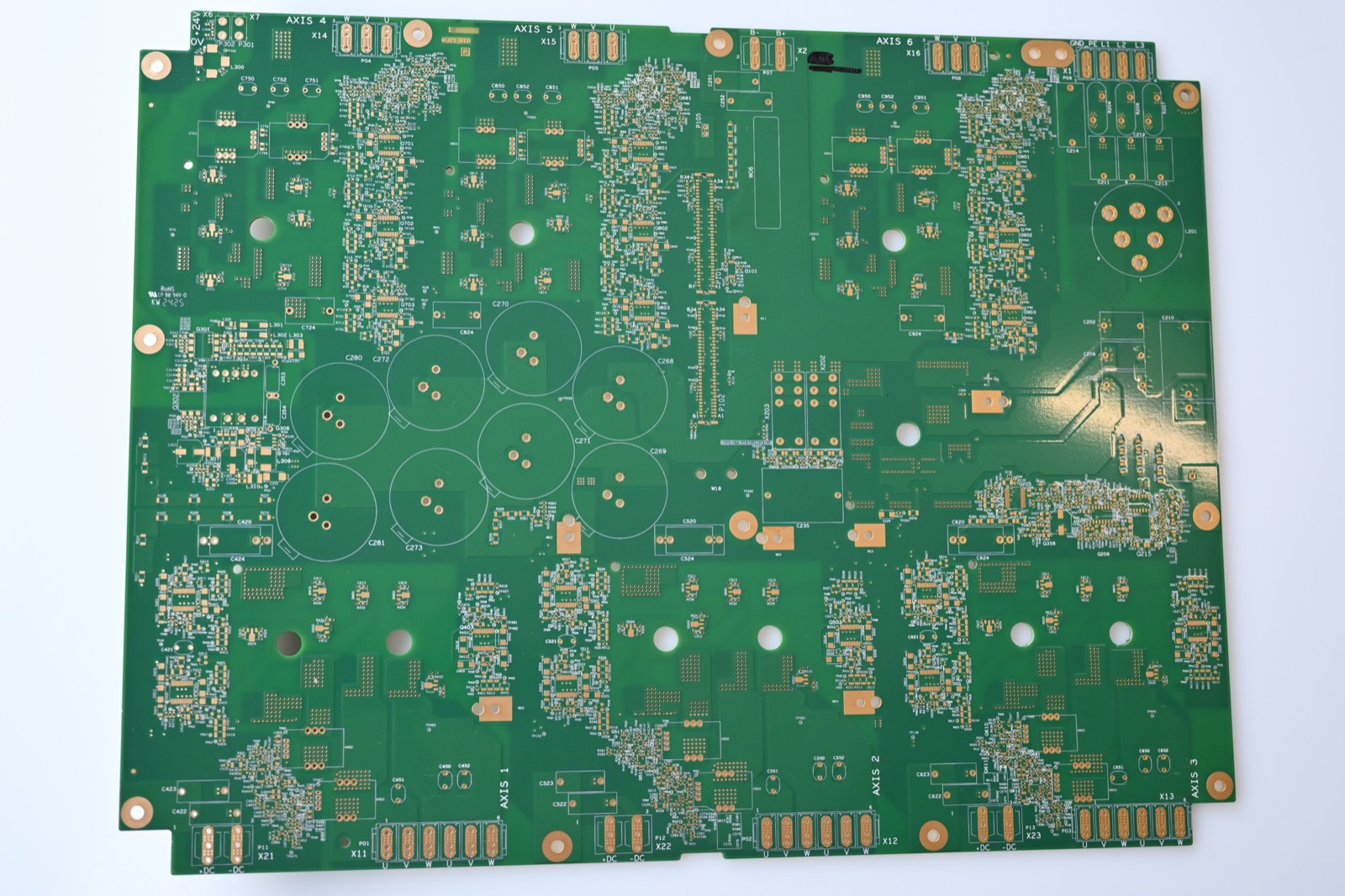
Statistical process control and CpK assessment, using a press-fit hole as the example. Author: Abbas Ashkan | LEXINGTON®
Precision can be measured. Process capability can be proven.
As electronic systems become more powerful and more complex, the demands on modern PCBs rise. In industrial electronics, power electronics, medical technology and e-mobility in particular, precision, process stability and reproducible manufacturing quality are decisive.
Meeting technical tolerances is only one part of a quality assessment. Just as important is whether a manufacturing process can meet those requirements consistently and reliably.
At LEXINGTON®, statistical process control (SPC) and Lean and Six Sigma principles are the basis for a data-driven view of manufacturing quality.
Cp and CpK: assessing process capability objectively
The statistical indicators Cp and CpK allow a differentiated assessment of manufacturing processes.
Cp describes the potential process capability from the spread of the measurements relative to the permitted tolerance range.
CpK additionally takes into account where the process mean lies within the specification limits.
A high Cp alone is therefore not enough if the process mean shifts noticeably towards one tolerance limit.
Only by looking at both indicators together do you get the full picture of process spread and the available process reserve.
Case study: statistical assessment of a press-fit hole
A study by LEXINGTON® shows how process capability can be assessed using real production data.
The subject was a press-fit hole with a nominal diameter of 0.600 mm and a tolerance of ±0.050 mm.
The statistical analysis is based on 125 measurements.
- Nominal diameter: 0.600 mm
- Tolerance: ±0.050 mm
- Number of measurements: 125
- Mean: 0.605216 mm
- Standard deviation: 0.008245 mm
- Cp: 2.02
- CpK: 1.81
- Defined CpK target: ≥ 1.67
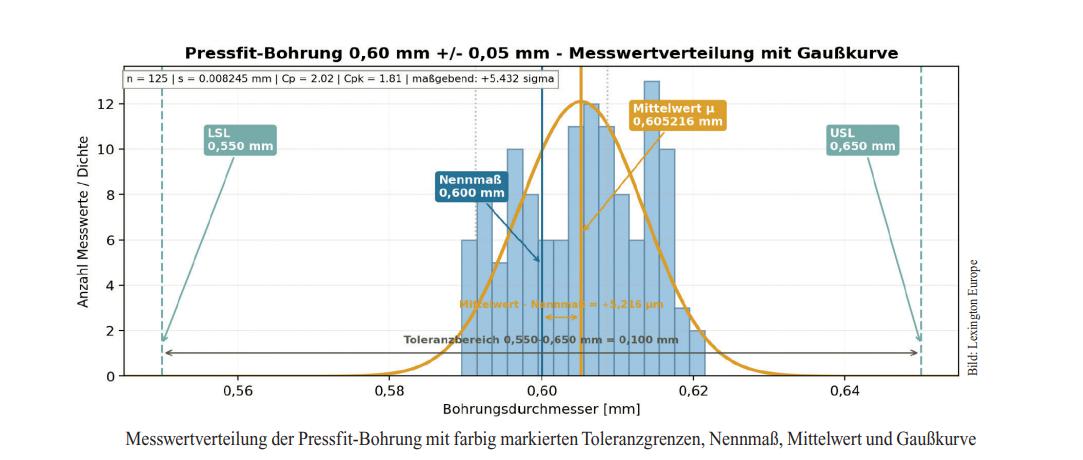
With a CpK of 1.81, the defined target of at least 1.67 is met and exceeded.
At the same time, the gap between Cp and CpK shows that the process mean lies slightly above the nominal value, and so closer to the upper specification limit.
The analysis therefore says more than whether the process is capable: it also provides valuable information for further process monitoring.
Quality is made in the process
Assessing individual measurements matters. For reliable series production over time, however, continuous monitoring of the relevant process parameters is what counts.
Tool condition, material properties, drilling processes and other production factors can change the process spread or the position of the mean.
Statistical process control makes it possible to spot such developments early and take appropriate action.
For LEXINGTON®, this approach is an essential part of our Lean and Six Sigma philosophy.
Our aim is not just to inspect quality in the finished product, but to secure it through stable, traceable manufacturing processes.
Published in PLUS magazine
Abbas Ashkan describes the statistical assessment of this press-fit hole in detail in his article “Prozessfähigkeit als Maßstab für Leiterplattenqualität” (process capability as a benchmark for PCB quality).
The article appeared in the trade journal PLUS 9/2026, published by Leuze Verlag.
LEXINGTON® – Precision. Passion. Reliability.